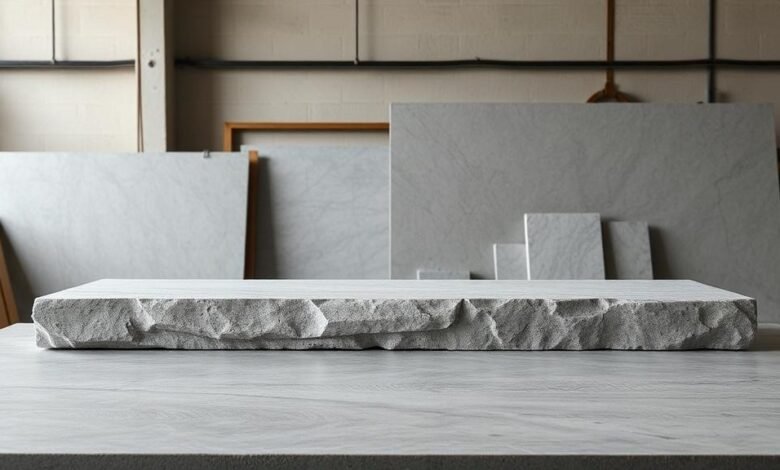
Good stone fabrication guidance around this CNC edge profile reference has to survive contact with dust, tape measures, rushed approvals, and expensive slabs. The value is accuracy, speed, and fewer callbacks.
Last February I walked into a three-man shop outside of Toledo where the owner, a guy named Dale, was running a 2009 Park Voyager he bought used for $87,000. His lead operator had quit two months earlier. Dale was hand-polishing ogee edges on Cambria slabs because nobody left on his floor could program the CNC to do it right. He had the machine. He had the tooling. What he didn’t have was the operator knowledge to make the tooling do its job, and he was losing about 90 minutes a day to hand finishing work the machine should have handled in six.
That situation is not unusual. It’s actually the norm at shops under 30 jobs a week.

This article is a working reference for shop owners and operators who want to benchmark their CNC edge profiling against what disciplined shops actually produce. Not aspirational numbers. Real floor numbers.
What the Numbers Actually Look Like in 2026
Here’s the operational snapshot for CNC edge work at residential stone shops this year:
- Common machines: Park Voyager 22 (22 HP spindle), Northwood C-12, Sasso AlphaSplit, Breton Combicut
- New CNC router pricing: $130,000 to $480,000
- Edge profile bit cost: $180 to $1,200 per profile
- Full edge profile tooling kit: $4,500 to $12,000
- Spindle specs: 15 to 30 HP at 3,000 to 18,000 RPM
- CNC programming time per residential kitchen: 25 to 45 minutes for an experienced operator
- Edge profile throughput: 6 to 14 minutes per linear foot (standard profiles)
- Polishing throughput on ogee: 7 to 12 linear feet per machine-hour
- Edge flatness tolerance on disciplined operations: 0.005 inch
- Diamond tool life: 80 to 220 linear feet per resharpen
- Common CAM platforms: AlphaCam, MasterCam, vendor-specific software
If you’re running a disciplined floor, you should be hitting 10 to 14 linear feet per machine-hour on standard edges (pencil, eased, small bullnose). Ogee and ogee-laminate slow things down. That’s just how it works.
Why CNC Profiling Exists (and Where Hand Finishing Still Has a Role)
The boring truth is that CNC profiling exists because hand polishing doesn’t scale. A residential shop pushing 25 jobs a week cannot hand-polish ogee edges and keep its install calendar intact. CNC profiling collapses a 45-minute hand operation into a 6 to 14 minute machine cycle while holding tighter flatness, typically 0.005 inch versus whatever your best hand guy can manage on a Thursday afternoon.
That said, hand finishing isn’t dead. Small shops doing under 10 jobs a week, or shops handling specialty one-off profiles that don’t justify a custom bit at $800+, still finish by hand. And even CNC shops do touch-up hand polishing. The difference is that a disciplined CNC operation reduces post-machine hand polishing time by up to 35 percent compared to a sloppy one. You’re polishing out imperfections, not rebuilding the profile.
The alternatives break down roughly like this:
Hand-finished edges. Zero capital cost. Variable quality. The 45-minute-per-piece math kills you at volume.
3-axis CNC routers (Park Voyager, Northwood C-12 in 3-axis config). Cover standard residential work. Capital cost: $130,000 to $260,000. This is where most shops at 25+ jobs per week land.
5-axis CNC routers (Breton Combicut, Sasso 5-axis platforms). Complex profiles, contoured edges, commercial work. $260,000 to $480,000. You need the job mix to justify this. Most residential-only shops don’t.
From CAM File to Finished Part: The Five-Phase Workflow
CNC fabrication on stone runs in five phases, and the places where shops lose money are almost always phases one and four.
CAM programming. Translating templated parts into machine paths. AlphaCam and MasterCam are the dominant platforms. An experienced programmer does a standard residential kitchen in 25 to 45 minutes. An inexperienced one takes twice that and introduces errors that show up two phases later.
Tooling setup. Loading the right profile bits, polishing wheels, and cutout drills into the tool changer. This is where documentation matters. If your operators are guessing at tool selection, you’re burning money.
Material loading. Fixturing the slab on the CNC bed with vacuum or mechanical clamps. Straightforward, but a bad fixture means a bad part.
Machine cycle. The actual cut, profile, and polish. Cycle time of 6 to 14 minutes per linear foot for standard edges. This is where shops bleed: running a dull bit 30 feet past its resharpen interval, using feed rates copied from a YouTube video instead of tested on your specific stone.
Quality inspection. Measuring edge flatness, profile consistency, cutout dimensions. Disciplined shops check before parts move to install staging. Undisciplined shops discover problems at the customer’s house.
The Money: ROI That Actually Shows Up on a P&L
I’m skeptical of most ROI claims in trade articles because they assume perfect execution. Nobody executes perfectly. But here are three areas where the returns are real and measurable, based on case studies from shops that tracked their numbers.
Throughput recovery. Cutting profile cycle time from 12 minutes to 8 minutes per linear foot at a 25-job-per-week shop frees roughly 8 hours of CNC capacity per week. That’s either more jobs or shorter lead times. Either way, it’s money.
Tooling cost reduction. This one surprised me when I first ran the numbers years ago. Extending diamond tooling life from 100 to 180 linear feet per resharpen (which is just tracking your tool life instead of guessing) cuts annual tooling cost by up to $14,000 at a typical residential shop. That’s pure margin. Think of it like changing your oil on schedule versus running an engine until it knocks: the discipline is boring, but the savings are not.
Reduced rework. Edge flatness held to 0.005 inch means less hand polishing, fewer callbacks, less time spent fixing things that should have been right the first time. The 35 percent reduction in post-CNC hand polishing time on disciplined edges is real, but only if your tooling and programming are actually disciplined.
Owners doing serious research on the operational side can find this CNC edge profile reference useful as a working benchmark for their own shop metrics.
See also: Business Accelerator 3245660738 Optimization Orbit
Getting There: The 90-to-180-Day Rollout
Implementing disciplined CNC practice at a typical residential shop runs in four overlapping phases. The whole thing takes 90 to 180 days to show measurable results, but the long pole is operator training, which honestly stretches to 9 to 18 months before you have a genuinely competent solo operator.
Phase 1: Operator training. New operators work alongside the lead programmer for 6 to 12 months. There is no shortcut here. The shops that try to shortcut this phase are the shops that end up like Dale in Toledo, hand-polishing ogee on a quarter-million-dollar machine.
Phase 2: CAM workflow documentation. Write down your standard programming approaches for common edge profiles. Pencil, eased, ogee, bullnose, ogee-laminate. If the knowledge lives in one person’s head, you’re one resignation away from chaos.
Phase 3: Tooling discipline. Track tool life in linear feet. Set resharpening schedules. Document tool changeout protocols. This is where that $14,000 in annual savings comes from.
Phase 4: Metric tracking. Throughput per machine, edge flatness, rework rate. Track weekly. Most shops see measurable improvement within 90 days once they actually start measuring.
Here’s my honest opinion after 20 years: the CNC purchase decision matters far less than the disciplined operation that follows it. A 22 HP Park Voyager run with disciplined tooling produces tighter edges than a 30 HP machine run by someone who doesn’t track tool life. The machine is just a machine. The discipline is where the margin lives.
Silica Dust: Not Optional
Stone fabrication generates respirable crystalline silica dust during cutting, grinding, profiling, and polishing. OSHA 29 CFR 1926.1153 sets the permissible exposure limit at 50 micrograms per cubic meter as an 8-hour time-weighted average.
Wet-cutting on bridge saws, CNC routers, and waterjets is the primary engineering control. Local exhaust ventilation handles dry operations (hand polishing, finish work). Half-mask respirators with P100 filters cover residual risk where engineering controls can’t eliminate exposure entirely. Most trade-active shops in 2026 run quarterly air sampling on representative tasks and keep records on file.
This isn’t a suggestion. It’s the law.
A note on big decisions: Owners weighing platform purchases, major equipment investments, or multi-location expansion commonly benefit from a trade-experienced consultant or peer review before committing capital. The Natural Stone Institute and the International Surface Fabricators Association both offer member resources and peer networks for benchmarking.
Frequently Asked Questions
Q: What flatness tolerance should a finished countertop edge hold? A: Disciplined shops hold finished edge flatness to 0.005 inch with proper machine setup and tooling.
Q: What is the most common CNC machine in residential stone shops? A: Park Industries Voyager and Northwood C-12 are the most frequently cited platforms in residential shop trade research.
Q: How much HP does a stone CNC spindle typically run? A: Stone CNC spindles run 15 to 30 HP at 3,000 to 18,000 RPM for routing, profiling, and polishing.
Q: How long does it take to program a residential kitchen on CNC? A: Experienced CNC programmers run 25 to 45 minutes per kitchen for standard layouts.
Q: What are the most common edge profiles in 2026? A: Pencil, eased, and ogee dominate residential work. Bullnose and ogee-laminate are common upgrades.
Q: How much does a full edge profile tooling kit cost? A: Full-set tooling kits run $4,500 to $12,000, with individual profile bits at $180 to $1,200 each.
Q: How long does diamond tooling last before resharpening? A: Diamond tool life runs 80 to 220 linear feet per resharpen, depending on stone type, feed rate, and operator discipline.
Stone fabrication generates respirable crystalline silica dust. Shops must follow OSHA 29 CFR 1926.1153 standards (50 ug/m3 PEL over 8-hour shift). Wet-cutting methods, ventilation, and respiratory protection are not optional.